So we left Halls Creek and headed towards home, sort of….
Our original intent was to take the Tanami Rd across the Tanami Desert to Alice Springs, but while at Purnululu a guy had told us about a "must see" place not far south of Halls Ck - Lake Gregory, a fairly permanent, large piece of water with abundant bird life and wild arabian horses. Arabian horses? We decided to go check it out.
Down the Tanami Rd a way, we first did a little detour to have a look at the Wolfe Creek Meteorite Crater, then on to a little place called Billiluna. Probably Billiluna's only claim to fame is that it's the first fuel in a long while when you come NW across the Tanami, and it marks the northern end of the famous Canning Stock Route.
We had to buy fuel in Billiluna, as well as a permit to travel through the Paruku Indigenous Protection Area which encompassed Lake Gregory. Driving into the tiny settlement, we were struck by the amount of rubbish lying around everywhere, as well as trashed and cannibalised cars and run down houses. As we cruised around looking for the IPA office and fuel we immediately thought the worst of the civic pride of the predominantly black residents. But first impressions aren't always correct, are they? The lady at the IPA office told us the locals were trying hard, but one in their midst with mental problems had a habit of walking around the community upturning all the garbage bins. Not the whole problem, but a fair part of it.
Anyway, we obtained our permit, and fuel, and headed off down the Canning Stock Route to our stop for the night - the permanent water of Stretch Lagoon. We settled in near the water's edge as the sun went down and enjoyed a quiet night in the middle of nowhere. The bird life was prolific, with lots of Galahs, White Cockatoos, Jabirus, and a couple of stately resident Black Swans.
Next day, onward down the Canning, with the road slowly deteriorating from initially quite good to bad, with some nasty corrugations. We had to go about 125 kms south on the Canning before turning east, and didn't know whether there would be a sign, but the map we had gave us lat and long coordinates for the turn so we bunged them into good old Sheila and carried on. Sure enough - we arrived at the coordinates, and there were two wheel ruts heading off to the east, just where we wanted to go.
We had seen two vehicles going the other way when we started on the Canning, but since then nothing. We were the only people out there and had another 150 kms to go before we hit Mulan, the next aboriginal community. Good thing we brought the satphone, we both thought. The track didn't get any better, but the payoff as we slowly circled around the south side of Lake Gregory was lots of bird life, including many Brolgas and a few Wedge Tailed Eagles (magnificent birds - rulers of the avian domain!), and the aforementioned horses.
These wild horses, all descended from a few Arabians which had been owned by Palatine missionaries in the mid eighteen hundreds, were set free when the Mission failed. They now number around 8,000 and are a pest, increasing in numbers by 15% a year, and destroying the fragile landscape. The government gave the land back to the aboriginals and said, "You guys manage it." The aboriginals now want to manage it - minimising the damage to their land by culling the horses, but the government won't let them. Figure that out!
But… the horses are magnificent. We saw 100s of them, sometimes standing and looking, and other times galloping beside us and across our path. Beautiful, majestic animals, tossing their heads and kicking up their heels. Maybe the indigenous owners could make a tourist attraction out of them?
We had intended to camp somewhere around this track, but never found a spot that appealed, so continued on until we rejoined the Tanami Rd and drove on until we hit the WA/NT border around sunset. There was a dusty little pullout within sight of the graffiti'd border sign, and that was where we made camp. Not much of a campsite, but the sunset was beautiful!

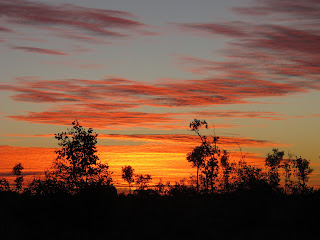
After breakfast, and topping up the tank with 60 litres from jerry cans, we hit the road again. Contrary to some of the horror stories we'd heard, the Tanami wasn't that bad and we pushed on all that day through to Alice Springs, pulling onto our allocated campsite about 6:30. We woke in the dark early hours of the morning - freezing! We pulled some warm pyjamas on, threw our spare doona on the bed, and crawled back under the covers to get a little warmer. I even put a beanie on my bald and very chilly head. After we plucked up the courage to clamber out of bed in the light of morning, I checked the temperature - 3 bloody degrees! After leaving the very warm Northwest, the Centre had dropped us into the full icy grip of winter.
Once we got into some appropriately warm gear it wasn't too bad, and after sending a fax to the Sherriff's Office in Sydney telling them I was in Central Australia and unable to front up for the required Jury Duty, getting some more supplies and a fairly decent coffee in Todd Mall, we headed out of town for our next play area - the West MacDonnell Ranges.
First stop was Simpsons Gap, then Standley Chasm. Like Echidna Chasm in the Bungles, this is very narrow with tall red cliffs which glow in the sunlight. Then another gorge called the Ellery Creek Big Hole, which was beautiful, but would have been better if it was warm enough to swim. We had quickly realised there would be no more swimming for us! Next, the Ochre Pits, a cliff really, of different colours of ochre which the original inhabitants would collect (men only, thank you!) to paint on their bodies for ceremonies. Then on to our destination for the day - Glen Helen Resort, setting up camp about 4. The temperature dropped quite quickly as we ate dinner, and we retreated fairly quickly to bed for another cold night.


After a slow start in the morning, we drove the short distance to Ormiston Gorge, and opted for the 6km "Pound Walk", which took us up over a saddle to a lookout on the cliff top rim of the Pound. The valley was huge, completely enclosed except for the narrow gap which drained it - Ormiston Gorge. The trail took us down onto the valley floor and along the mostly dry river bed towards the restriction of the gorge. We were captivated by the beauty of our environment, especially the dry river beds with stately, gnarled old River Red Gums and rocks of wonderful colours. The red cliffs gradually closed in and we negotiated our way around the permanent waterholes of the gorge before emerging at the carpark after a three and a half hour excursion we had enjoyed immensely.
Back to Glen Helen and we went to have a look at G H Gorge, which turned out to be a 15 minute walk because to get past the major waterhole at the entrance, you either had to do some rockclimbing moves with a fall into the icy water a possibility, or swim it! The old rock climber in me was a bit keen, but Susie said an emphatic No Way, so we had plenty of time to get cleaned up for dinner in the restaurant at the resort, which turned out to be really good. Susie hit the jackpot with the 'roo fillets. Sensational. After dinner we wandered into the lounge where Alice resident, singer and photographer Barry Skipsey was sitting on a stool with his guitar, singing well known outback ballads as well as his own compositions. Pretty good, and he had a slide show of his pics of the local area showing on a big screen behind him as he sang, which were also very good.


After finishing our walk at Ormiston the previous day, Susie was pretty upbeat and eyeing off Mt Sonder in the distance. Mt Sonder, 4th highest mountain in the NT, is the last stage of the Larapinta Trail, a 10 day walk out of Alice, and a 16km, 6 hour return trip. "Why don't we go walk up that tomorrow?", she said. "Uh, yeah, okay."
A lot of walkers get up about 2 am to get to the top to watch the sunrise, but it was bloody cold again during the night and we didn't quite make it that early, getting to the trailhead at around 9! Up we went, a solid 3 hours 15 of up, up, and more up, on ankle testing rough and broken rock. But the view from the top was fabulous - 360 degrees of West MacDonnell Ranges. The return walk was a bit quicker, making a 6 hour round trip. We were tired little puppies that night back at Glen Helen.
Next morning, we drove to Kings Canyon via the Mereenie Loop, a very scenic gravel road through aboriginal land. On the way we looked out west towards Gosse Bluff, a many hundreds of thousands of years (or more?) old meteor impact crater 5 kms in diameter. From a distance it looks like a range of mountains, but it's actually a circular ring of walls hundreds of metres high thrown up by the impact. But we were short on time and a trip out there will have to wait for another time.
Arriving at Kings Canyon Resort we set up as quickly as possible and set off for the Canyon, 6 kms away. What a spectacular place! After a steep climb to the top of the canyon, we followed a 6km loop trail around the rim and down into the "Garden of Eden" - a permanent, deep waterhole in the upper reaches of the canyon surrounded by lush growth. The ruler straight vertical cliffs blew me away.
Back at the Resort we had dinner, then headed over to the bar area to listen to a young guy named Oz singing a few tunes.
Uluru, or Ayers Rock, was our next destination. Along the way we saw wild camels, donkeys, and horses. About 50 kms before Uluru came into view, the impressive Mt Connor - a massive mesa - appeared out of the desert plain to the south. We tried to tee up a tour of the mountain over the next couple of days, but weather prevented it. After checking in at Yulara and setting up, we drove to the Cultural Centre to try to soak up some of the aboriginal history of the place, and then went out to watch the sunset on the Rock, which didn't amount to much because of cloud cover.
It rained steadily that night. Wouldn't you know? We're out in the desert in the centre of Australia, and it's raining. But it gave us a look at a different Uluru to the one most people see. In the morning we set out rugged up and in wet weather gear to walk around the Rock. I don't know what it was about that big lump, whether it was learning more about it's significance to the indigenous people, or just it's appearance, but for me the place had a real presence, almost a living thing. I had always said I wanted to climb it, despite the wishes of the traditional owners, but now I was here I found my desire had evaporated. Even if I had wanted to, the climb was closed because of the rain. It took us about 3 hours to walk around it in intermittent light rain, watching small silver streams running down it's flanks.
Back at Yulara, as we had not been able to do anything special on the day of my birthday, we treated ourselves to a nice dinner at the Desert Sands Hotel.
The Olgas, or Kata Tjuta to the traditional owners, was our play area next day. Again we did a loop walk of around 3 hours, around and in between the massive red domes, had lunch and then walked up Walpa Gorge, ever narrowing between two huge domes.
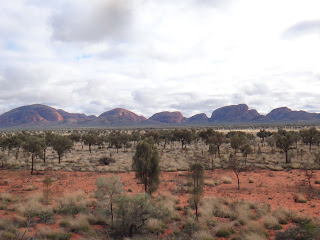


We left Uluru - Kata Tjuta NP enroute to Coober Pedy - opal capital of the world, where 80% of the population lives underground. A long drive that day - 730 kms, broken only by lunch and a stop at a spot where you could look out over the wide expanse of Lake Eyre South. We'd have loved to do the 50 odd km drive to Lake Eyre North, but that will have to wait for the Flinders Ranges trip at another time soon. We wanted to have a good look around Coober Pedy, so southwards we went, arriving after dark. John's Pizza Restaurant had been recommended to us, and not feeling like cooking for ourselves, that's where we went. You wouldn't think an opal town in the middle of Oz would serve up a fabulous garlic prawn pizza, would you? But that's what they did - almost, but not quite, as good as Alimento in Collaroy.
Next morning we were up and at it, and I was just amazed by the mullock heaps, EVERYWHERE! Driving into town in the dark the previous night I just hadn't seen them, but in the bright light of day… omigod.`Giant ones, middle sized ones, right down to small ones only a couple of feet high out in nowheresville, created by a small prospecting hole. The place is full of holes, many not covered, and signs saying "BEWARE - DON'T RUN - DEEP SHAFTS - DON'T WALK BACKWARDS". There's a 5,000 sq km (I think!) area around Coober Pedy where opal mining is allowed, and most mines are fairly small operations, so these nests of mullock heaps are all over the place.
During the day we did a tour of one of the larger working mines, checked out Faye's Underground House - dug out of solid rock on her own for 3 years, then for another few with the help of 2 other ladies, complete with 3 bedrooms, ensuite bathroom, wine cellar, party room, etc, went to the underground Catholic Church, the underground Greek Orthodox Church, and an underground bar for a thirst quencher. Susie was so taken by the little Catholic church she dragged me back there for mass at 6:30 that evening. The father noted our new faces immediately and asked Susie if she would like to read the Epistle. "Oh, I'm sorry, I don't have my glasses", says Susie. "That's okay, you can borrow mine!" Foiled. So Susie got to stand up in front of the congregation - all 10 of us! - and do the reading.
We also visited an area they call The Breakaways. It's an area of small, beautifully coloured and eroded hills and mesas about 30kms out of town. Great for sunrise or sunset shots.


Wanting to sample at least a small part of the Oodnadatta Track, we left CP heading east on the gravel again for the tiny town of William Creek, resident population 12, with a ripper old outback pub, a couple of fuel pumps, an airstrip, and the station homestead. We pulled up outside the pub, and went inside. It was a bit early in the day for a beer, but waddayaknow, they had a proper coffee machine! So we had a caffeine fix and a good chat with the publican before heading off on our short Oodnadatta Track sampler. (A future trip that's been banging around in my head is to link the Strezlecki, Birdsville, and Oodnadatta Tracks, sampling a whole bunch of iconic outback pubs along the way!) Along the way we pulled off the road to have lunch at the northern end of a rusting old bridge from the old Ghan Railway. After a few minutes, we realised we weren't quite alone. At the other end of the bridge were 2 magnificent wedge tailed eagles. One was sitting on a rail of the bridge, holding something he had caught in his talons while he ripped bits off with his beak. His partner watched from the top of a sand hill about 15 metres away. After a short time the boss (I'm presuming it was "he") put down the lunch, and his partner then flew over to join him and finish it off. Unfortunately, they were just too far away for the zoom on my little camera to get a good shot. We tried to get closer by car, but they were onto us, and as soon as I popped my head up from behind a dune to get The Shot, they were away on the wind.


We turned off the Track again and headed back towards the highway through Roxby Downs and BHP's much publicised Olympic Dam Mine, stopping for the night at Woomera. The usually dry, dead flat plains around Woomera were green. In fact it seemed like most of South Australia was green. The driest state in the driest continent on earth was green. Even the aptly named Moon Plain, east of Coober Pedy on the road to William Creek, usually brown, was green. And yet western Victoria and western NSW are still in drought.
Moving right along..
We motored on down to the Adelaide Hills to visit my brother David and his wife Sue. Slept in a bedroom with four solid walls and our own bathroom, which was pretty cool! Our aim in pushing down from Alice was because we wanted to be at Dave's place for the Monday night "Hoot". "The what?" I hear you say. The Hoot is a get together of local musicians, lasting a little over an hour, where each artist or small group gets to do one song. They can also do backing for others as required, and the whole thing goes out live to a local community FM station. Dave does mostly rock and blues, and the old bastard wasn't too bad, for a brother!
We filled the next day very pleasantly visiting Dave's mate Joe for coffee and a look at his art, having lunch with Dave and Sue's daughter Sal and her kids, and a wander around the local bush paths.
Next stop, and the last major stop before we spied the Pacific, was Broken Hill. Cold. Very cold at night. But I think most of the southern half of OZ was pretty cold at about that time, with an Antarctic draft coming up from the south.
We stayed a couple of nights, checked out the town - loved the old buildings in the main street - visited the Sculpture Hill and Culture Walk, and drove out to the old mining town of Silverton. Mostly an artists' hang out now, the main topic of conversation was the recent approval by BH Council of a large bunch of wind electricity generators on the hills surrounding the town. As one prominent, and very good artist said, "I've been painting this landscape for 25 years. If those bloody things go up, I'm out of here!" Surefire way to divide a community!
The other thing we did in BH was go into town to a pub to watch the 2nd Rugby League State of Origin match on TV. As everyone in Oz knows, this was also the night Kevin Rudd deposed Julia Gillard as Labor Party leader and PM. There were 2 big screens in the big bar at this pub - one showing the big game, and one showing the other unfolding big game in Canberra. Naturally, the sound was from the football game. The big bar was packed as you would expect, but do you think anyone - ANYONE - was watching the most momentous event in our recent political history unfolding? Other than Susie and me, not a soul. Nobody gave a rat's! I even mentioned the unfolding drama to the young barmaid as I bought a drink, and she said, "Who?" I gave up.
Oh, the main game? Queensland won that one as well!
From BH we could almost taste the salty air of Collaroy, and pushed on through Wilcannia, Cobar and Nyngan before calling a halt for the night in the little town of Trangie.
Up early in the morning we hit Dubbo fairly quickly and turned left, deciding to give the Blue Mountains a miss and go via the Golden Hwy through Dunedoo, Denman, the Upper Hunter Valley and the F3. Pretty good drive it was, too, and we had the added bonus of one of the trip's best coffees in a little retro 50s cafe in Dunedoo.
It rained for much of the last day's drive. Sydney had been soaked by 2 weeks of heavy rain, and it was still raining on and off as we backed the trailer down the driveway in the last light of day, but we didn't care too much. It was good to be home.


