After the events leading to our early departure from Albania, we arrived in the town of Corfu, on the island of the same name, in somewhat of an emotional turmoil, with our thoughts and conversation continually returning to "the incident". But....
Here we were with a new town, and a big new island to explore, so Valerie, Susie and I set about finding the Hotel Konstantinopoulos, which turned out to be a lovely old place on the waterfront of the old town, only a short cab ride from the ferry port. After getting squared away we asked the lady at the desk for a recommendation for an eatery, and were directed to a small cafe not far away. We ate, drank probably a little more red than usual while still analysing our deliverance, and then retired to bed.
One of our first impressions of Corfu was how clean the place was after Albania. We spent the next day wandering the old town. A walk around the waterfront, a look at the old fort which used to guard the old town, lunch, and a bit of exploring of the narrow cobbled streets had us back at the "Kon" for a clean up before looking for dinner.
Our cabbie the previous day had recommended a restaurant called Rex, we managed to stumble on it without trying too hard, and had the best meal we had had in a long time - an absolute taste sensation after the bland and unimaginative offerings of Croatia, Montenegro and Albania (with the one exception in Tirana).
Susie had booked us 5 nights at an unbelievably cheap price in a town on the NW coast called Paleokastritsas (try saying that after a few drinks!) which looked pretty good, so we hired a car for the day to do a tour of the northern half of the island, checking out our "deal" and dropping off our big bags on the way around.
It turned out to be a pretty good day. We arrived in Paleokastritsas around 11, had a quick look around the beautiful bays and cliffs, decided we would love it, met our future hosts Spiros and Sofia, and were just leaving when Susie spied "Sky Sports" chalked on a board outside the place straight across the lane - Angels. We had been on the lookout all morning for a spot that might have the NRL Grand Final on, so walked in, found the boss who channel surfed for a bit, and Bingo. The players had just walked off for half time, so we settled in, got a beer, and had a thoroughly good time watching Manly survive a spirited fightback by the Warriors to take out another GF. Yahooo!!!
Back in the car, we continued our tour of the island. The north coast was flat and a little uninteresting, but the NE coast was like the west, steep sided little bays with beautiful little pebbly beaches and villages. We found a great little restaurant called Eucalyptus in the north corner of one of these little bays, had a superb lunch followed by a swim, then continued back towards Corfu.
Next morning we headed off on foot to the Green Bus Terminal - just up the road we were told, saw the sign, and managed to take the wrong one of 2 roads going off the intersection and walked about 2 kms around a great loop instead of the 200 metres we should have, missing our targeted 10:00 departure. Never mind, the coffee and people watching was good while we waited for the 11:00 bus.
Our 5 days in Paleokastritsas was just what we were after - some chill time just looking around the local area. We were 5 minutes walk from a beautiful little bay where we swam, easy walking distance to local restaurants, and our little studio apartments had table and chairs outside where we sat in the evenings for a gin and tonic or 2 before heading in search of dinner.
Susie and I walked up the steep track to the village of Lakones, high above the water, where we met George, who sold everything including his own cumquat wine (a bit sweet for our taste), had a coffee at Bella Vista where we admired the sensational view of the coastline, and chatted to Alkis, an absolute artist with Olive Wood. We were very keen on Alkis's work, but had no money with us, so promised him we would return, which we did a couple of days later.
Just after our arrival our host Spiros had asked if I would like to go fishing with him, and so on our 3rd day, off we went. We trolled around a couple of rock islands for a while, hooking 3 tuna but only landing one, the other two frustratingly managing to get off just before we got them in the boat. The hits dried up then, so we headed seaward. I steered in the general direction of Italy while Spiros dug into the forward locker and came up with his secret weapon - a cut down kid's bicycle frame with a large spool where the sprocket used to be and a short length of fishing rod bolted to it. The frame slotted upside down into a hole in the gunwhale and the pedals were used to haul up the line.
I soon found out why... Spiros' secret spot is in 250m of water! To this line he attaches a ganged arrangement with 30 hooks on it, a massive sinker, and down she goes. Down, and down, and down, until finally the sinker hits bottom. You can only just feel the tugs on the line as the fish arrive, but it's almost impossible to know if you've actually hooked one, unless it's huge of course, and that didn't happen! What we did get was about 20 little buggars not more than 8 inches long, with big eyes, that would have been thrown back in Oz. But hauling all that line up - mate, I felt like a grinder in a tacking duel on a racing 12 metre!
The fish were actually not bad eating though. The evening of the next day, Spiros expertly cooked them all whole in a grill over his bbq, and we ate them with our fingers, pulling the flesh away from the fine bones. Much easier than trying to do it with a knife and fork, and quite tasty.
While Spiros and I were out on the water, Ken and Maggie, friends from Sydney arrived to hook up with us for a couple of days, so the next day four of us hired a boat and had a day exploring the cliffs, bays and beaches of this beautiful coast. Motoring slowly along the bottom of the cliffs, we stopped here and there to swim, snorkel, and eat. At one little bay, the beach was made up of quite loosely packed small pebbles, most no more than 2cms in length. Coming out of the water from a swim, you could lie down on these lovely sun warmed pebbles and they moulded themselves to your body, kinda like nature's own hot stone massage. Bliss!
On the agenda next was a walk to the local monastery, which just happened to be on one of the best sites in the area, high up on a seaside crag with great views both directions along the coast, then in the afternoon another visit to our olive wood working mate Alkis, up on the hill, for a couple of purchases.
At the end of our very enjoyable five days, Ken and Maggie headed off on their own again to explore the island, our new Pommy mate Valerie decided to stay on for a few days for a bit of personal time, and Susie and I caught the bus back to Corfu, and the ferry to Patras, our gateway to the Peloponnese. Over our couple of weeks together Susie and I had grown quite fond of Valerie, and hope the friendship continues.
Back in Corfu, we caught the ferry, nine hours, to Patras on the NW coast of the Peloponnese, arriving at 9:30 at night in absolutely torrential rain. By the time we found a cab we were wet through, but soon found our hotel and hit the hay. Next morning we picked up a car from Mr Avis, a perky little Citroen C1, and headed off down to Olympia, site of the Ancient Olympics, first contested in 776BC.
If you take the main road down the coast it's a one and a half hour trip, but not us - we had our GPS Sheila on the job, who Susie and Lynne had turned into Richard while I was away in Oz. Richard took us the "scenic" way, on back roads over the mountains, through tiny villages, with great views. It took about 3 hours, but was a great drive.
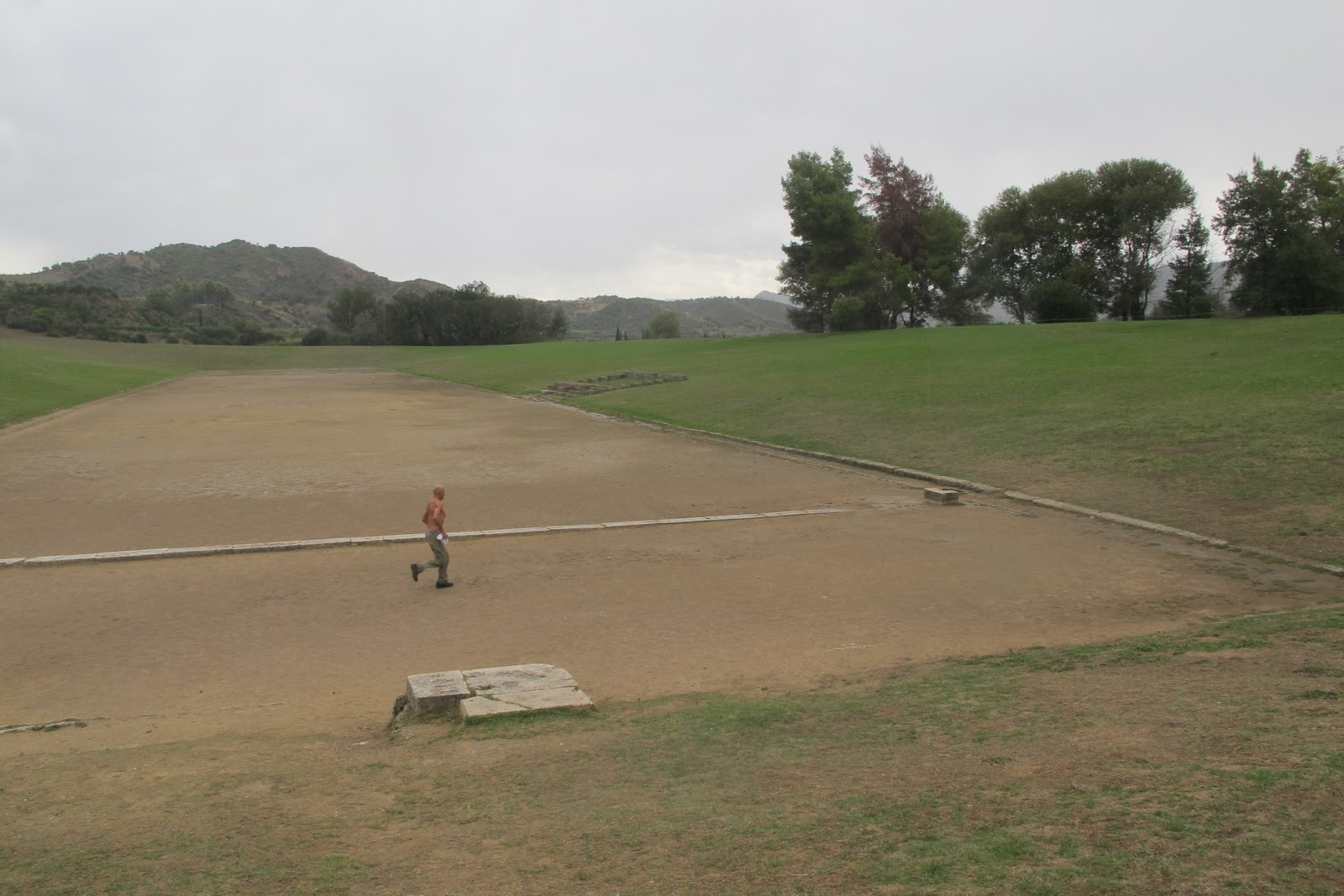
After checking in to our family run Hotel Pelops we headed for the Ancient Olympics site. This place just grabbed me straight away. The ruins of the buildings were not in the same league as places like the Parthenon, but for me the place had so much atmosphere - as we walked around reading about how the athletes trained and competed, I could see it all happening. Then we walked into the ancient stadium. By this time it was drizzling rain, so we had the place pretty much to ourselves, which made it all the more enjoyable. As we stood there looking at it, I could almost see the athletes on the track and hear the crowds cheering. Then Susie broke the spell, telling me to go down and have a run on the track so she could take a photo. And how good is that? It's not every day you get to have a jog around the very same track used by the Ancient Olympians!
There's also an archaelogical museum and an ancient olympics museum on site, so there was plenty to soak up.
For the next day's entertainment, after getting the low down from our host Theo, we drove up into the mountains to the Temple of Apollo. Just getting there was a bit of an adventure, as driving around the narrow and winding mountain roads, there were fallen rocks everywhere, some quite large, and mud and gravel washed across the road in lots of places. It had just been rain in Olympia, but we were thinking boy, this area must have had a real downpour. Then we started to see patches of snow on the side of the road. We knew it was cold up there, throwing extra gear on when we got out of the car, but snow? Bloody hell. Then when we talked to the girl at the ticket booth (we were fully half of all her customers for the day) we found out the "snow" was actually left over drifts of hail from the tremendous storm they had the previous evening. That explained all the rocks!
The Temple itself was pretty interesting, but lost a lot of it's impact by being completely covered by a giant tent structure while they undertake a big renovation project. Some of the big columns are held by scaffolding and metal straps, awaiting new marble blocks which are being made in a nearby onsite warehouse. Apparently the footings on one side of the temple are subsiding, so it's a big project to stabilise the structure.
Our next stop was a little mountain top village called Kopiroiva. Presiding over the village, on top of a rocky crag, was another ruined castle. You can't pass up a ruined castle, can you, so up we went to check it out, along with an old Byzantine church in the village which was in the throws of a reno project.
Then it was on to our target, the Lousios Gorge. We had been told, and read, that this gorge was very spectacular, with some cliff-hanging monasteries, and great walking, so we were looking forward to getting there. And we did, but on the wrong side of the gorge!
By the time we realised we had missread the map somehow and were not where we wanted to be, we were halfway down a long descent into the gorge, so thought, buggar it, let's keep going down to the bottom and hope there's a bridge to the other side. (We could actually see the road we should have been on.) The narrow twisting bitumen became narrow twisting rough bitumen, then narrow twisting gravel, then narrow, twisting and very rutted, until at last we reached the bottom of the gorge. We turned a sharp bend and there it was - a very old, very narrow, stone arch bridge with side walls. It was a good thing we were in our little C1, because with door mirrors folded in I was just able to creep across.
Okay, so now for those monasteries. Another series of switchbacks had us climbing to the top of the gorge, then halfway back down again before we found what we were looking for - the path to one of the monasteries. About a kilometre along the path and we arrived, lucky we had dilly dallied along the way because a sign said the monastery was closed through the afternoon and opened again to visitors at 5:00, which just happened to be the time as we arrived at the door. We knocked, and after a minute or two were admitted to this spectacular cliff-hanging old monastery. Words really can't describe the amazing setting and the building itself. One of the monks made us coffee while we looked around.
We had about 2 hours of driving to get back to Olympia, so didn't get back to our hotel until 7:45, and then had to go in search of dinner, but it was a good day.
Our foray the next day didn't really amount to much, other than a pleasant drive in the countryside, and a visit to a local winery, but the day after... well, that was a bit of an excursion.
Susannah, the Australian wife of Theo (been there 35 years, but you can still tell she's an Aussie!) told us about a beautiful gorge she had recently discovered, and gave us directions. She told us to drive north to a little village called Nemouta, where we were to ask at the local coffee joint for directions, while she made a phone call.
On our arrival, the coffee joint was closed, and we were casting around wondering what to do, when two young guys came walking down a lane, and walked straight over to the car. We gave them Susannah's card from the hotel and told them what we wanted to do. One of them spoke no English, and the other, quite well educated we found out through the course of the day, spoke a little, but we got the message across. They had a bit of a parlay, then Nik, the older of the two, said "Wait 15 minutes." and he and his mate Baros walked off. Sure enough, 15 minutes later they returned, said "We take you, come on", and we were off.
What followed was four and a half hours of walking and scrambling down into and out of the local gorge, on everything from old gravel roads to single bush track, to no track at all in river beds. By the time we were approaching the village on our return Susie and I were flagging, but our 29 and 25 year old Greek mates were bouncing along in front like it was a walk in the park. On the way we had found our way to two beautiful waterfalls hidden deep in the gorge, a beautiful little church, and the ruins of old settlements long abandoned. Back in the village, our new mates wouldn't accept payment of any sort, so we settled for buying them a drink, and we settled down outside the minimart with a bunch of the local kids in attendance, laughing and enjoying the strangers.
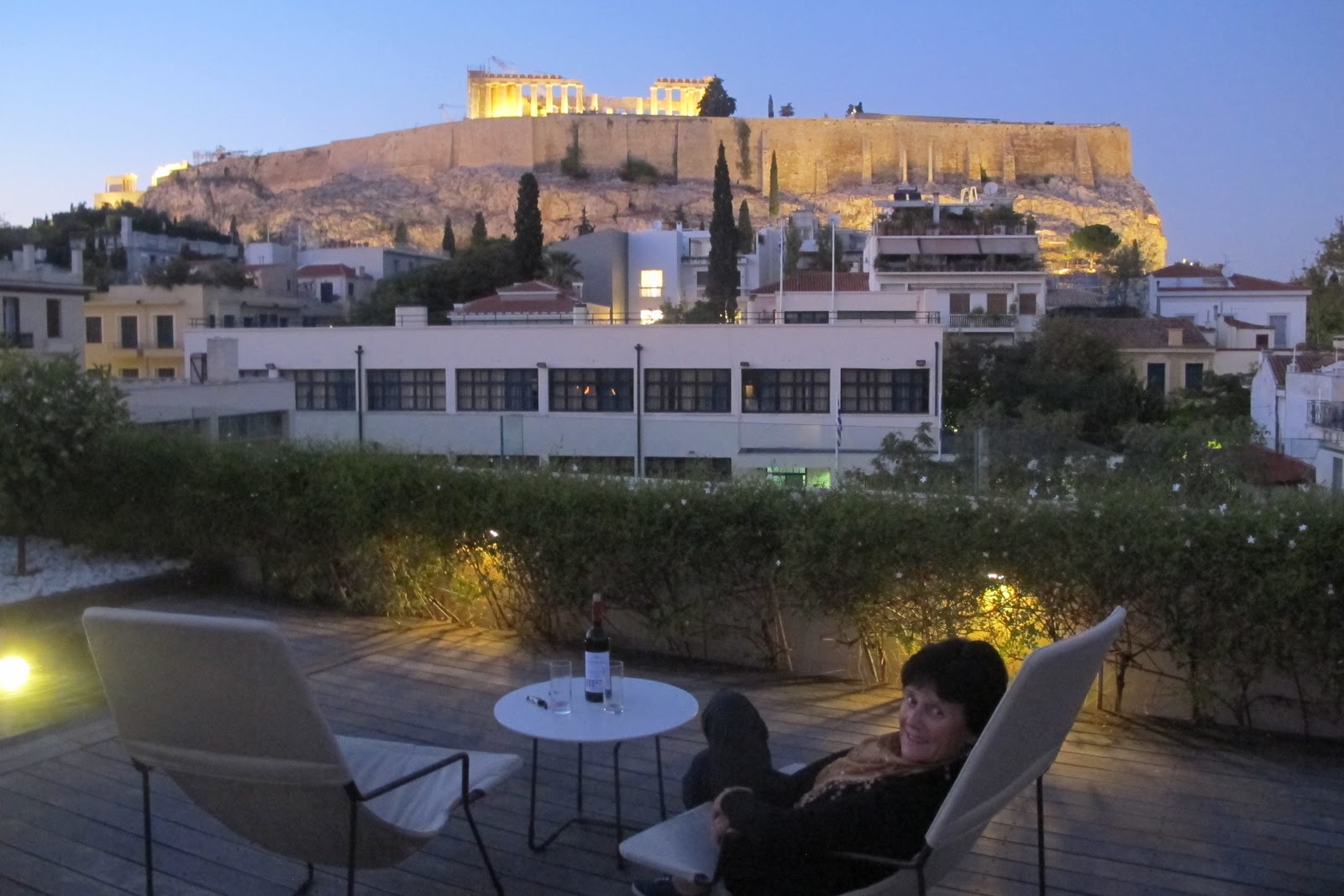
Loading up our little Citroen next day we took the faster but boring coast road back to Patras, dropped it off to Mr Avis, and caught the bus to Athens. About 3 hours later we pulled up in a cab outside our home for the next 2 nights, the very nice Herodion Hotel, with a rooftop bar which looked across to the nearby Acropolis. By now it was late afternoon and the Acropolis was closed, so we walked just down the street to the relatively new (Athens Olympics?) Acropolis Museum, which gave us a great history of the settlement on and around the Acropolis. That night we dined at a restaurant, Sofritas, not far away that reminded us how good food in big cities can be. Yum.
Our last day in Greece, and Europe, was a biggie. Told by the guy at the hotel desk that because of a general strike, the Acropolis would be closed, we got up at a leisurely hour, had breakfast and wandered out, intending to circumnavigate the hill, but once outside could see people up there. Realising our hotel had given us a bum steer, we made straight for the entrance, and the crowds. The place was alive with people on tours - great crowds of people with numbers stuck on them so they could be returned to their owners when they got lost, following guides holding up big cards with corresponding numbers on them. But, despite the crowds, we were just blown away by the place. The Parthenon is such a huge and impressive structure, from any angle, and I was really impressed with the restoration work going on, replacing broken parts of the structures with new marble, cut exactly to size. After spending a good while around the Parthenon and Temple of Athena we walked down into Agora, the ancient marketplace of the Acropolis, then to Hadrians Gate, and the soaring columns of the Temple of Zeus.
From there it was only a short walk to the Panathaeic Stadium, where the first Olympics of the modern era were held in 1896. Wow, what an impressive place. Like Ancient Olympia, the place had an aura about it. You could feel the atmosphere and imagine the roar of the crowd.
After the 1896 Olympics, it was allowed to decay quite badly, but in the lead up to the recent Athens Olympics the decision was made to return it to it's former glory, helped in great measure by a filthy rich Greek guy who paid for all the marble - and there is millions of tonnes of it! Every single square inch of the place, except for the track, is marble. All the seating, right up to the back row, and there must be at least 50 rows, is dazzling marble. No grass, no timber, no metal, no dirt - just marble. We were told by our audio tour that it was only used in the recent Olympics for the Archery and the finish of the Marathon, but what a finish. I can't remember who won, but it must have been quite a feeling running into that Stadium.
And that, apart from dinner at our new favourite restaurant again that night, completed our European tour. Next day we flew out of Athens for Bangkok and Chiang Mai for 5 days before our flight home to Sydney.
Thursday, October 20, 2011
Friday, October 7, 2011
Escape from Albania
Geographically, Albania is a lot like Montenegro - beautiful, rugged mountains and spectacular coastline, but, the country is in a mess, literally!
My lasting memories of Albania :
An endless parade of unfinished and abandoned buildings, rubbish everywhere - on the sides of roads, in ravines, in and on the banks of rivers, bad roads, manic drivers, beautiful rugged mountains and valleys, beautiful coastline being ruined by rubbish, and friendly people.
We're told that before Communism was ousted, Albania did not have a rubbish problem. They didn't have plastic bags or bottles, and almost everything was recycled in some way. But since democracy and access to western consumerism arrived, the locals have adopted the throwaway habits of the west without the benefits of a regular rubbish collection. Hence, piles of rubbish - plastic of every type, bottles, cans, and building rubbish as well - gets dumped on the sides of roads, rivers and ravines. What doesn't get dumped, gets burnt, submerging much of the country under a blanket of smoke haze.
That said, we had some memorable experiences - many good, and one bad which resulted in our early exit from the country.
We arrived by bus from Montenegro in the northern Albanian town of Shkodra and found our way with no problems to our small hotel. Our host, John, organised us a light but very tasty late lunch in the restaurant, after which we went for a walk in the town. There was a car free plaza full of cafes which we wandered down, and were struck by the number of men sitting in groups drinking coffee, smoking and talking. Practically no women. We found out later from our tour guide that unemployment is very high, but a lot have some sort of black market income. Someone is obviously making money there, because there are a lot of late model, upmarket Mercs, Audis and Beemers tooling around. We ate that night in the restaurant of our hotel, an old Ottoman building, very atmospheric, and I had a specialty of the house - Krap fish, and it's definitely not.
Next morning Susie and I decided to grab a couple of the free to use bicycles at the hotel and brave the roads. Shkodra is quite flat, so pedalling around is no problem and heaps of people do it, from young to quite old, and everyone rides along slowly on crappy old single speed grids with not a helmet to be seen anywhere. (Not even motor bike riders wear them.) After riding around the city for a bit, we ventured out of the CBD to the river, crossed it on an old timber bridge, through a very poor area with lots of Roma hanging about, and along the bank to where it empties into Lake Skadar. The ride by the water could have been quite nice and scenic if it wasn't for the piles of rubbish lying off the side of the road. The tragic thing is that the locals don't seem to notice it - it's just normal.
Another walk around town filled in the following morning until we met our Australian tour guide Gail and her Albanian partner and our driver, Ardi. Our fellow travellers were Valerie from England, young Canadian brothers Justin and Jonathan, and Ann, a Canadian teacher living and working in Tirana, the Capital. Off we went to a nearby town called Lezhe, where we drove out along a very long gravel road to a fish restaurant by Lake Skadar. The food was supposed to be great. It wasn't. It was just okay, but I had a good case of the runs that night, so maybe it wasn't even okay!
We followed lunch with a drive up into the nearby mountains to look at the little Church of St Anthony. Thousands of pilgrims walk from the valley up to this church and the nearby cave in which St Anthony used to devote himself to prayer. The walls of the cave are black and slippery with melted wax from candles lit by pilgrims.
Saturday Sep 24, we all piled into our VW Transporter and set off on a rough 2 hour drive on winding unmade mountain roads to the Koman Ferry. This old vehicular ferry starts near the wall of a Chinese built dam, and winds for a bit over 2 hours through spectacular water filled mountain gorges. Arriving at the dam wall on the dry side, we then had to drive through a kilometre long, single lane, rough hewn, unlit tunnel to the water side of the wall and the waiting ferry.
As soon as we emerged from the tunnel, all except Ardi left the vehicle and watched the loading. This was an hour and a half of thorough entertainment, as a half dozen guys yelled and gesticulated wildly at drivers of all manner of vehicle from large semi-trailer to micro car, cramming them into every available square foot of space. We finally left the dock with the very last vehicle, a small truck, parked diagonally across the slightly raised loading ramp.
Once unloaded at the other end, we had another spectacular 2 hour mountain drive to our day's destination, the beautiful mountain valley of Valbona.
It was a pity we only had one night in Valbona, because we loved the place. The valley is very narrow, hemmed in on both sides by high, rugged ranges. We stayed at a guest house run by Alfred, an Albanian who has travelled, his American wife Catherine, (A New Yorker would you believe!?), and their big mountain dog puppy Pongo. A violent electrical storm a couple of days before had knocked out the power to our rooms, but it didn't matter - we got by well with head torches and candles, and it all added to the atmosphere.
These guys are really trying to set an example for others in the country by recycling as much as they can (not easy in such a remote location), and keeping the place clean. They also farm their own trout, which were delicious on a plate for dinner!
We had a short walk along the river after our arrival mid afternoon, which was nice, but we all agreed a couple of extra nights would have been great to enable us to get some more walking in, and just appreciate the place more.
In the morning, Alfred's mum fed us a breakfast of champions before we headed off on another teeth rattling but very scenic mountain drive out of Albania and into Kosovo, passing through the very bustling and prosperous looking towns of Gjakove and Prizren, finally turning up at "The White House", a blindingly white replica of the real thing in manicured green lawns, for lunch. They love America in Kosovo and Albania because of the support and visit from George W a few years back. A long drive back into Albania and all the way to our hotel in Shkodra finished off this very long day of mostly driving, but it was interesting to see the difference between prosperous looking Kosovo and poorer, trashier Albania.
We had a visit to the 15th century Rozafa Castle next morning. Rozafa was the name of a woman who, legend has it, was bricked into the walls of the castle as a sacrifice to ensure the strength of the building. She was a young mother still breast feeding her son, so entreated the builders to leave holes in the wall for her breast, face and knee, to enable him to feed. There is a sculpture of this scene in the museum at the castle. Fact or Fiction? Who knows, but it's a good story.
Coming out of our parking spot on the top of the hill near the castle, Ardi put the right front wheel into a culvert with a crash, resulting in a torn tyre and bent wheel rim. Gail apparently warned him as he started forward, but he went ahead anyway, with an expensive result. I didn't think much about it at the time, as we boys all pitched in to change the wheel and get going, but this may have been a tipping point in rising tensions between Gail and Ardi. Gail being the boss of, and brains behind this fledgling tour outfit probably didn't sit will with Ardi's Albanian maleness, and her frequent chipping of him about his over ordering at dinners, occasional inattention while driving, and other things, served to build the tension. Worse was to come.
Heading south now to the capital, Tirana, we had a walk around the interesting bits before a fabulous "traditional Albanian" dinner at Era restaurant. Poor Susie missed this dinner, opting to stay in our hotel and try to sleep away a nasty bug she had caught, but it was great food, and a real change from the mostly bland offerings in Croatia and Montenegro.
Checked out the National History Museum next morning - pretty good - and then drove north to the town of Kruje, which was the home and headquarters of Albanian National Hero, Skanderbeg. Back in the 14th century, this guy rallied the Albanian people to a defense against the invading Ottomans, winning 23 of the 25 battles he fought against the invaders. There are memorials and sculptures of this guy all over the country, and a fearsome looking warrior he was, too. There was a replica of his sword in the memorial in Kruje, and it would take a strong man just to pick it up, let alone wield it effectively in battle.
There's another large statue in Kruje - of George W Bush waving to the multitudes, and a street named after him as well.
The highlight of this day, though, was a visit to the home of a typical Albanian family who run a small farm, mostly growing apples. Gail and Ardi had met them a few months previously, and they made us very welcome, taking us into their sparsely furnished but spotless home and treating us to their homemade Raki and brandied peaches. We were shown through their orchard and met their resident cow, who was almost ready to calf. Villy, the man of the house, goes to Italy for a few months each year, picking fruit, to top up the family finances. They didn't have much money, but made us feel like part of the family, and there were lots of smiles and laughs as Ardi interpreted and the Raki got passed around.
From there it was on to the pretty town of Berat (if you don't see the constant rubbish) and a late tour of the castle there. It was very late afternoon when we started with our guide, Valbona, and most of us were ready to go to our hotel, but you don't want to miss anything, do you? So off we went, finishing in the dark, which was actually quite dangerous with lots of steps and practically nil lighting. After dinner in the rooftop restaurant of our hotel, we crashed.
After a quick walk around the town in the morning, we again piled into the VW and headed south again, stopping just out of town at a winery named Cobo. We had drunk some of their very drinkable product a couple of nights before, so were keen to check out the winery. We were shown around the winemaking facility and then to the tasting room, where we sampled some very nice wines, best being an '07 red. After buying a few bottles we were heading for the VW when we stumbled on Grandpa and his still, making Raki. He gave us a sample. WHOOOWEE, talk about firewater! Must have been almost pure alcohol. The road then took us over a winding mountain pass with great views, and eventually to the coast again in the small beachside town of Himare, and our stop for the next 2 nights at a nice little family run hotel right on the beach. The water was beautiful, and I got in a couple of nice morning swims.
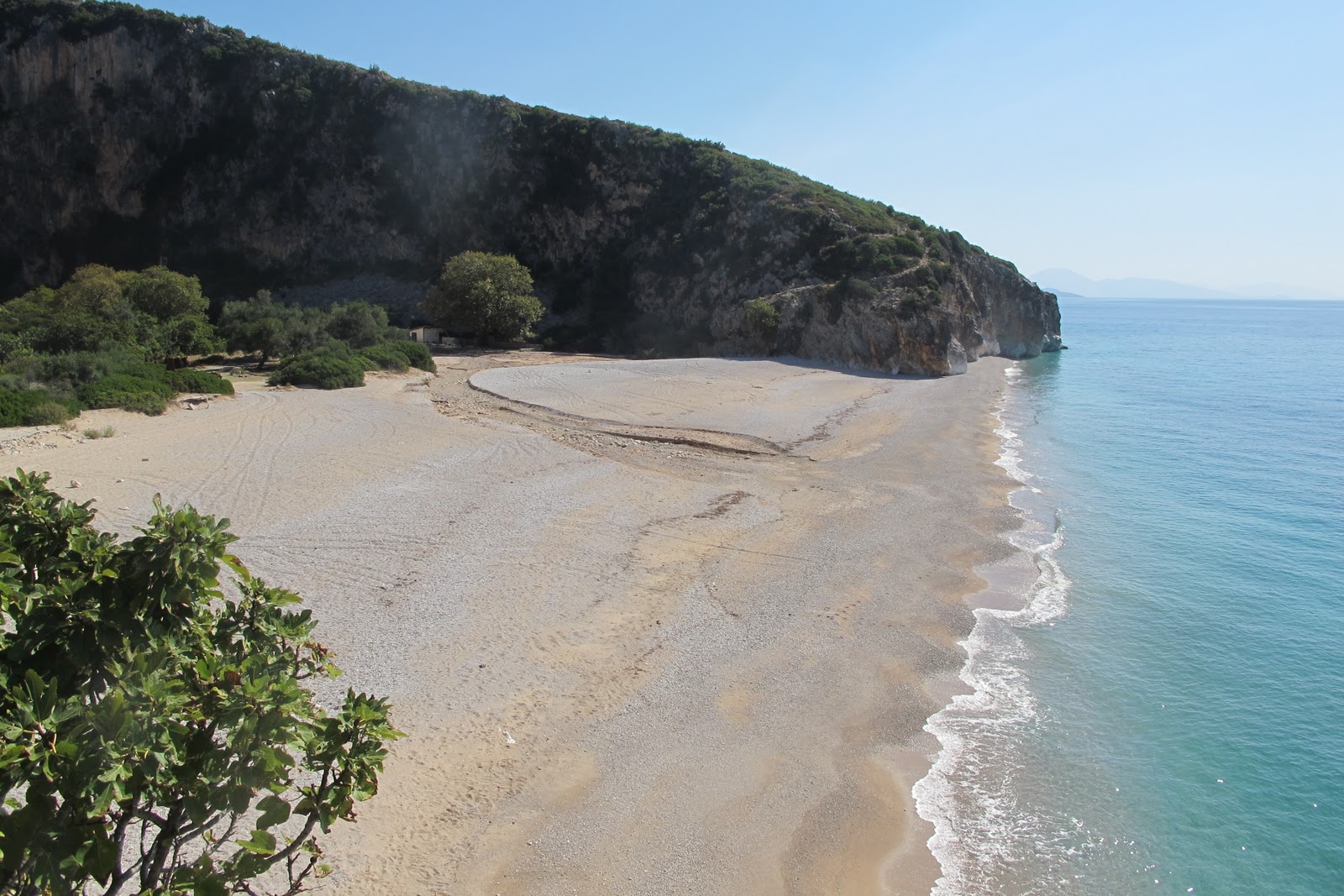
The next day we backtracked up the coast a bit to a side road near a canyon we had seen the day before. From the end of the road there was a rough track of about a kilometre leading down to the mouth of the canyon and a fairly rubbish free and deserted Gjipe Beach. We all dived in and swam along the cliffs, finding a nice little cave to swim into. On our walk back out we decided to do our bit for the "Clean Up Albania" campaign (they really could do with Ian Kiernan's help) and picked up 6 plastic bags full of cans and plastic bottles. A mere drop in the ocean, but at least we thought we had done something. We then stopped for lunch at a beachside cafe in a village called Dhermi, where I foolishly ordered a plate of grilled shrimp. The cook must have had a nap while they were on the hotplate I reckon, because they were incinerated. Ah, well.
Dinner that night was better - the boys went off to the local butcher and bought a selection of meat, which a mate of our hosts kindly bbq'd for us. Match it up with some salad, plenty of local wine and Raki, and there was a party going on! I noticed that Gail and Ardi were sitting at opposite ends of our long table during our dinner, but didn't think anything of it, and Gail was having a few drinks, which wasn't totally professional. Susie and Valerie, being more observant of these things, told me they had had a row, and weren't speaking to each other.
We left Himare for Saranda, further down the coast, at 1000 next morning, stopped at another 18th century castle for a look, then continued on, the road taking us high above the ocean. As the road started descending again into some hairpin switchbacks, Ardi cut the first one too sharply, finding gravel and lurching the tail out. We all made "take it easy" type comments, but he accelerated towards the next corner, braking late and hard and lurching around it, then hit the accelerator hard again towards the next hairpin. By this time the alarm bells were well and truly ringing and we were all screaming, "SLOW DOWN!" Ardi then mashed down on the brakes and brought us to a juddering halt just before the bend, turned to Gail and said, "This is all your effing fault! I told you not to effing touch the radio while I'm driving!" and carried on with more words in the same vein.
We managed to get him to proceed very slowly to a point past the next couple of bends, where we got him to pull over and we all got out. Valerie was in tears, Gail was in tears, and the rest of us were rather shaken up. He then launched into another tirade at Gail, then turned to us, telling all of us how it was all Gail's fault. It was a good five minutes before we could calm him down enough to shut up and listen to us. He finally began to understand that his personal problems with Gail were not the big issue, that he had recklessly endangered all our lives, and that we were not getting back in the van with him driving.
Thankfully, he handed over the keys, Justin was elected driver, and we proceeded calmly and quietly for the next half hour to our hotel in Saranda.
As soon as we stepped out of the van, Ardi pulled some clothes out of their bag, stuffed them in a plastic bag, muttered goodbye, and walked off up the street. Gail was in tears again and apologising for the whole affair, and Susie, Valerie and I knew our tour of Albania was over. Susie and I had intended to finish our tour in another 2 days, come back to Saranda and get the ferry to Corfu, but decided to bail out right there and get the boat that afternoon, and Valerie decided to come with us. Gail understood, and we all had a quiet lunch together before they dropped us at the ferry. The boys had decided to stay with Gail and continue the tour.
And so ended our tour of Albania.
My lasting memories of Albania :
An endless parade of unfinished and abandoned buildings, rubbish everywhere - on the sides of roads, in ravines, in and on the banks of rivers, bad roads, manic drivers, beautiful rugged mountains and valleys, beautiful coastline being ruined by rubbish, and friendly people.
We're told that before Communism was ousted, Albania did not have a rubbish problem. They didn't have plastic bags or bottles, and almost everything was recycled in some way. But since democracy and access to western consumerism arrived, the locals have adopted the throwaway habits of the west without the benefits of a regular rubbish collection. Hence, piles of rubbish - plastic of every type, bottles, cans, and building rubbish as well - gets dumped on the sides of roads, rivers and ravines. What doesn't get dumped, gets burnt, submerging much of the country under a blanket of smoke haze.
That said, we had some memorable experiences - many good, and one bad which resulted in our early exit from the country.
We arrived by bus from Montenegro in the northern Albanian town of Shkodra and found our way with no problems to our small hotel. Our host, John, organised us a light but very tasty late lunch in the restaurant, after which we went for a walk in the town. There was a car free plaza full of cafes which we wandered down, and were struck by the number of men sitting in groups drinking coffee, smoking and talking. Practically no women. We found out later from our tour guide that unemployment is very high, but a lot have some sort of black market income. Someone is obviously making money there, because there are a lot of late model, upmarket Mercs, Audis and Beemers tooling around. We ate that night in the restaurant of our hotel, an old Ottoman building, very atmospheric, and I had a specialty of the house - Krap fish, and it's definitely not.
Next morning Susie and I decided to grab a couple of the free to use bicycles at the hotel and brave the roads. Shkodra is quite flat, so pedalling around is no problem and heaps of people do it, from young to quite old, and everyone rides along slowly on crappy old single speed grids with not a helmet to be seen anywhere. (Not even motor bike riders wear them.) After riding around the city for a bit, we ventured out of the CBD to the river, crossed it on an old timber bridge, through a very poor area with lots of Roma hanging about, and along the bank to where it empties into Lake Skadar. The ride by the water could have been quite nice and scenic if it wasn't for the piles of rubbish lying off the side of the road. The tragic thing is that the locals don't seem to notice it - it's just normal.
Another walk around town filled in the following morning until we met our Australian tour guide Gail and her Albanian partner and our driver, Ardi. Our fellow travellers were Valerie from England, young Canadian brothers Justin and Jonathan, and Ann, a Canadian teacher living and working in Tirana, the Capital. Off we went to a nearby town called Lezhe, where we drove out along a very long gravel road to a fish restaurant by Lake Skadar. The food was supposed to be great. It wasn't. It was just okay, but I had a good case of the runs that night, so maybe it wasn't even okay!
We followed lunch with a drive up into the nearby mountains to look at the little Church of St Anthony. Thousands of pilgrims walk from the valley up to this church and the nearby cave in which St Anthony used to devote himself to prayer. The walls of the cave are black and slippery with melted wax from candles lit by pilgrims.
Saturday Sep 24, we all piled into our VW Transporter and set off on a rough 2 hour drive on winding unmade mountain roads to the Koman Ferry. This old vehicular ferry starts near the wall of a Chinese built dam, and winds for a bit over 2 hours through spectacular water filled mountain gorges. Arriving at the dam wall on the dry side, we then had to drive through a kilometre long, single lane, rough hewn, unlit tunnel to the water side of the wall and the waiting ferry.
As soon as we emerged from the tunnel, all except Ardi left the vehicle and watched the loading. This was an hour and a half of thorough entertainment, as a half dozen guys yelled and gesticulated wildly at drivers of all manner of vehicle from large semi-trailer to micro car, cramming them into every available square foot of space. We finally left the dock with the very last vehicle, a small truck, parked diagonally across the slightly raised loading ramp.
Once unloaded at the other end, we had another spectacular 2 hour mountain drive to our day's destination, the beautiful mountain valley of Valbona.
It was a pity we only had one night in Valbona, because we loved the place. The valley is very narrow, hemmed in on both sides by high, rugged ranges. We stayed at a guest house run by Alfred, an Albanian who has travelled, his American wife Catherine, (A New Yorker would you believe!?), and their big mountain dog puppy Pongo. A violent electrical storm a couple of days before had knocked out the power to our rooms, but it didn't matter - we got by well with head torches and candles, and it all added to the atmosphere.
These guys are really trying to set an example for others in the country by recycling as much as they can (not easy in such a remote location), and keeping the place clean. They also farm their own trout, which were delicious on a plate for dinner!
We had a short walk along the river after our arrival mid afternoon, which was nice, but we all agreed a couple of extra nights would have been great to enable us to get some more walking in, and just appreciate the place more.
In the morning, Alfred's mum fed us a breakfast of champions before we headed off on another teeth rattling but very scenic mountain drive out of Albania and into Kosovo, passing through the very bustling and prosperous looking towns of Gjakove and Prizren, finally turning up at "The White House", a blindingly white replica of the real thing in manicured green lawns, for lunch. They love America in Kosovo and Albania because of the support and visit from George W a few years back. A long drive back into Albania and all the way to our hotel in Shkodra finished off this very long day of mostly driving, but it was interesting to see the difference between prosperous looking Kosovo and poorer, trashier Albania.
We had a visit to the 15th century Rozafa Castle next morning. Rozafa was the name of a woman who, legend has it, was bricked into the walls of the castle as a sacrifice to ensure the strength of the building. She was a young mother still breast feeding her son, so entreated the builders to leave holes in the wall for her breast, face and knee, to enable him to feed. There is a sculpture of this scene in the museum at the castle. Fact or Fiction? Who knows, but it's a good story.
Coming out of our parking spot on the top of the hill near the castle, Ardi put the right front wheel into a culvert with a crash, resulting in a torn tyre and bent wheel rim. Gail apparently warned him as he started forward, but he went ahead anyway, with an expensive result. I didn't think much about it at the time, as we boys all pitched in to change the wheel and get going, but this may have been a tipping point in rising tensions between Gail and Ardi. Gail being the boss of, and brains behind this fledgling tour outfit probably didn't sit will with Ardi's Albanian maleness, and her frequent chipping of him about his over ordering at dinners, occasional inattention while driving, and other things, served to build the tension. Worse was to come.
Heading south now to the capital, Tirana, we had a walk around the interesting bits before a fabulous "traditional Albanian" dinner at Era restaurant. Poor Susie missed this dinner, opting to stay in our hotel and try to sleep away a nasty bug she had caught, but it was great food, and a real change from the mostly bland offerings in Croatia and Montenegro.
Checked out the National History Museum next morning - pretty good - and then drove north to the town of Kruje, which was the home and headquarters of Albanian National Hero, Skanderbeg. Back in the 14th century, this guy rallied the Albanian people to a defense against the invading Ottomans, winning 23 of the 25 battles he fought against the invaders. There are memorials and sculptures of this guy all over the country, and a fearsome looking warrior he was, too. There was a replica of his sword in the memorial in Kruje, and it would take a strong man just to pick it up, let alone wield it effectively in battle.
There's another large statue in Kruje - of George W Bush waving to the multitudes, and a street named after him as well.
The highlight of this day, though, was a visit to the home of a typical Albanian family who run a small farm, mostly growing apples. Gail and Ardi had met them a few months previously, and they made us very welcome, taking us into their sparsely furnished but spotless home and treating us to their homemade Raki and brandied peaches. We were shown through their orchard and met their resident cow, who was almost ready to calf. Villy, the man of the house, goes to Italy for a few months each year, picking fruit, to top up the family finances. They didn't have much money, but made us feel like part of the family, and there were lots of smiles and laughs as Ardi interpreted and the Raki got passed around.
From there it was on to the pretty town of Berat (if you don't see the constant rubbish) and a late tour of the castle there. It was very late afternoon when we started with our guide, Valbona, and most of us were ready to go to our hotel, but you don't want to miss anything, do you? So off we went, finishing in the dark, which was actually quite dangerous with lots of steps and practically nil lighting. After dinner in the rooftop restaurant of our hotel, we crashed.
After a quick walk around the town in the morning, we again piled into the VW and headed south again, stopping just out of town at a winery named Cobo. We had drunk some of their very drinkable product a couple of nights before, so were keen to check out the winery. We were shown around the winemaking facility and then to the tasting room, where we sampled some very nice wines, best being an '07 red. After buying a few bottles we were heading for the VW when we stumbled on Grandpa and his still, making Raki. He gave us a sample. WHOOOWEE, talk about firewater! Must have been almost pure alcohol. The road then took us over a winding mountain pass with great views, and eventually to the coast again in the small beachside town of Himare, and our stop for the next 2 nights at a nice little family run hotel right on the beach. The water was beautiful, and I got in a couple of nice morning swims.
The next day we backtracked up the coast a bit to a side road near a canyon we had seen the day before. From the end of the road there was a rough track of about a kilometre leading down to the mouth of the canyon and a fairly rubbish free and deserted Gjipe Beach. We all dived in and swam along the cliffs, finding a nice little cave to swim into. On our walk back out we decided to do our bit for the "Clean Up Albania" campaign (they really could do with Ian Kiernan's help) and picked up 6 plastic bags full of cans and plastic bottles. A mere drop in the ocean, but at least we thought we had done something. We then stopped for lunch at a beachside cafe in a village called Dhermi, where I foolishly ordered a plate of grilled shrimp. The cook must have had a nap while they were on the hotplate I reckon, because they were incinerated. Ah, well.
Dinner that night was better - the boys went off to the local butcher and bought a selection of meat, which a mate of our hosts kindly bbq'd for us. Match it up with some salad, plenty of local wine and Raki, and there was a party going on! I noticed that Gail and Ardi were sitting at opposite ends of our long table during our dinner, but didn't think anything of it, and Gail was having a few drinks, which wasn't totally professional. Susie and Valerie, being more observant of these things, told me they had had a row, and weren't speaking to each other.
We left Himare for Saranda, further down the coast, at 1000 next morning, stopped at another 18th century castle for a look, then continued on, the road taking us high above the ocean. As the road started descending again into some hairpin switchbacks, Ardi cut the first one too sharply, finding gravel and lurching the tail out. We all made "take it easy" type comments, but he accelerated towards the next corner, braking late and hard and lurching around it, then hit the accelerator hard again towards the next hairpin. By this time the alarm bells were well and truly ringing and we were all screaming, "SLOW DOWN!" Ardi then mashed down on the brakes and brought us to a juddering halt just before the bend, turned to Gail and said, "This is all your effing fault! I told you not to effing touch the radio while I'm driving!" and carried on with more words in the same vein.
We managed to get him to proceed very slowly to a point past the next couple of bends, where we got him to pull over and we all got out. Valerie was in tears, Gail was in tears, and the rest of us were rather shaken up. He then launched into another tirade at Gail, then turned to us, telling all of us how it was all Gail's fault. It was a good five minutes before we could calm him down enough to shut up and listen to us. He finally began to understand that his personal problems with Gail were not the big issue, that he had recklessly endangered all our lives, and that we were not getting back in the van with him driving.
Thankfully, he handed over the keys, Justin was elected driver, and we proceeded calmly and quietly for the next half hour to our hotel in Saranda.
As soon as we stepped out of the van, Ardi pulled some clothes out of their bag, stuffed them in a plastic bag, muttered goodbye, and walked off up the street. Gail was in tears again and apologising for the whole affair, and Susie, Valerie and I knew our tour of Albania was over. Susie and I had intended to finish our tour in another 2 days, come back to Saranda and get the ferry to Corfu, but decided to bail out right there and get the boat that afternoon, and Valerie decided to come with us. Gail understood, and we all had a quiet lunch together before they dropped us at the ferry. The boys had decided to stay with Gail and continue the tour.
And so ended our tour of Albania.
Subscribe to:
Posts (Atom)